Published · Updated · Grillz Medellín
Silver: the entry point
Solid 925 silver gives a striking mirror finish, especially on bigger sets or combined with iced stones. It is many people's choice for a first set, a way to try the look without a big investment, or an occasional-wear set for parties and events.
Its weak point is that it tarnishes with prolonged air and saliva contact, so it needs more frequent cleaning than gold to keep its shine. In exchange, at COP 250,000 per tooth, it is by far the most affordable option in the whole catalogue.
Chrome / dental gold: an underrated middle ground
A tough alloy with a golden tone very close to gold at a glance, priced near silver at COP 320,000 per tooth. It is a good option if you want the gold colour without committing yet to real karat gold jewellery pricing.
It does not carry the intrinsic value of karat gold, but it also does not tarnish as fast as silver and holds up well to daily wear. Many people use it as a "middle step" before moving on to 14K or 18K gold.
9K, 14K and 18K gold: choosing a karat
Higher karat means more pure gold in the alloy: richer colour and, naturally, higher price. 9K gold is harder and the cheapest of the three (COP 900,000 per tooth); 14K is most customers' favourite balance (COP 1,250,000); 18K has the deepest yellow and is usually gentlest on sensitive gums (COP 1,500,000).
White, yellow and rose gold cost exactly the same at the same karat — colour choice is purely aesthetic. See every karat and colour combination in styles before deciding which looks best against your skin and your usual jewellery.
What about iced pieces with stones?
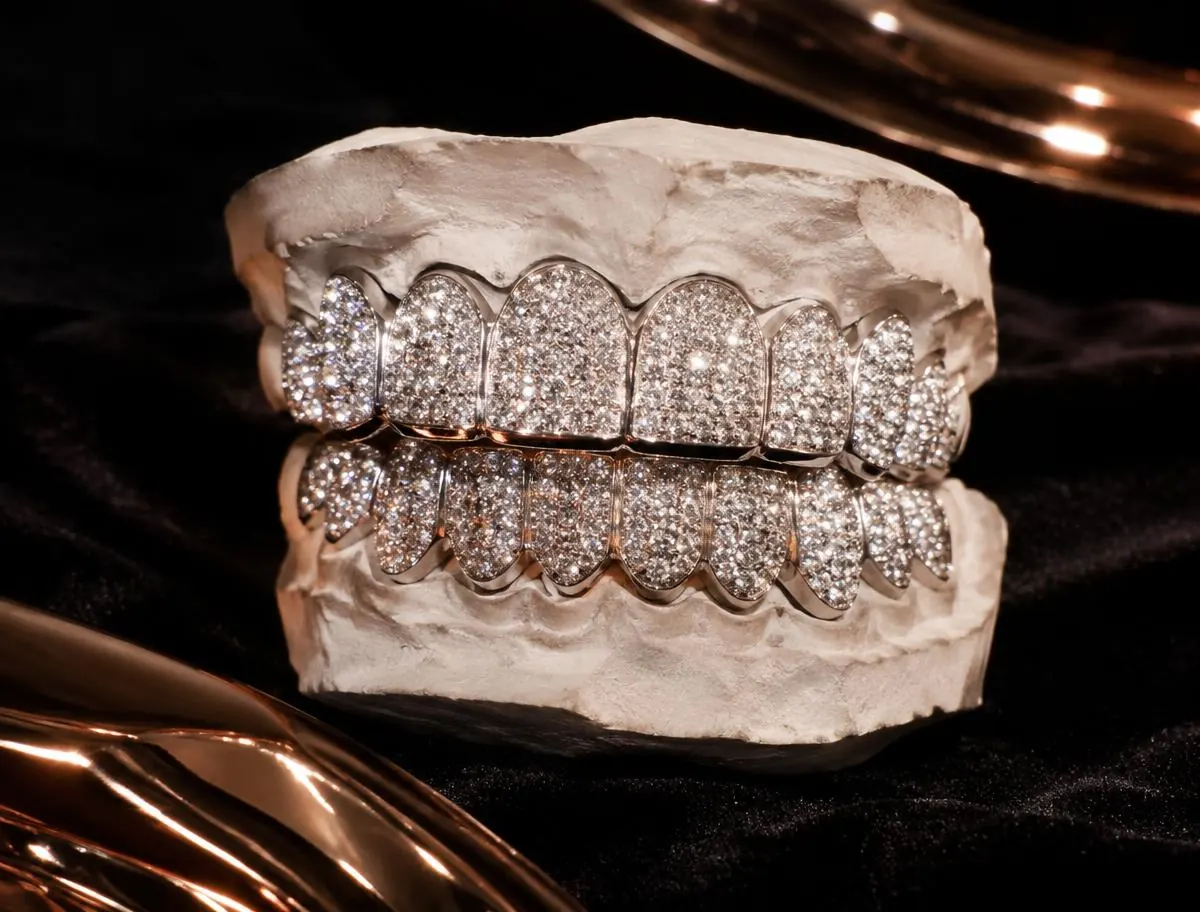
Both metals work well as a base for moissanite. On white silver, moissanite gives a very bright "all-ice" look from COP 500,000 per tooth, perfect for anyone who wants the diamond effect without a gold budget. On gold, iced pieces start from COP 1,250,000 per tooth and give a warm contrast between yellow metal and white stones.
We do not run a fixed table for lab-grown or natural diamonds: those are quoted individually by stone size, clarity and count, always before any deposit is taken.
Durability and day-to-day maintenance
Gold does not tarnish or dull over time, so if you plan to wear your grillz several times a week for years, 14K or 18K gold pays off that investment better: less intensive cleaning, less maintenance, and shine that stays consistent.
Silver needs a slightly more disciplined cleaning routine, but it is not complicated: a silver cloth or cleaner once a week keeps it spotless. See the full routine in how to clean and care for your grillz.
Does metal affect dental health?
No, as long as the metal is quality and the fit is custom: both 925 silver and our 9K-to-18K golds are stable in contact with saliva and contain no nickel. If you have especially sensitive gums, higher-karat gold is usually the gentlest option against soft tissue.
You can read more on this, including warning signs and basic care, in do grillz damage your teeth?.
How to decide for your case
If it is your first set, you will wear it for special occasions, or you want to try the look before committing, start with silver: the financial risk is low and the visual impact is just as strong. If you will wear it daily for years and want something that never dulls, go straight for 14K or 18K gold.
Staying in areas like Provenza or Envigado? We can bring samples of both metals to you so you can decide seeing the colour against your skin in natural light. Price both options side by side in the configurator and compare full pricing on prices.
Weight in your mouth and speaking comfort
Silver and gold of similar karat weigh about the same tooth for tooth, so the comfort difference between the two metals is minimal. What really changes the feel in your mouth is set size: a single loose tooth feels very different from a full arch, regardless of metal.
If this is your first time wearing grillz, we recommend starting with a small set, two to four front teeth, in whichever metal you prefer, and scaling up to a full arch once you are used to talking and smiling with the piece in.
Resale and long-term value
Karat gold retains real material value because it contains measurable pure gold, which silver and chrome/dental gold do not offer in the same way. We do not sell it as a financial investment, but it is a real factor if you care about the piece holding value over the years as well as looking good.
That said, the main reason to choose a metal should still be your budget and how you plan to use it, not a resale expectation. Most of our customers buy to wear, not to store.
Mixing metals within one set
The whole set does not have to be the same metal: some customers combine gold on the front teeth, the most visible ones when smiling, with silver on the sides, to stretch their budget without sacrificing visual impact where it matters most.
You can also mix karats, for example 18K on the central incisors and 14K on the rest, or combine yellow and white gold in the same set for a two-tone effect. All of these combinations are built in the configurator and priced automatically tooth by tooth.
Our quick recommendation
No big budget or first time: 925 silver from COP 250,000 per tooth. Want the gold tone for a little more: chrome/dental gold at COP 320,000 per tooth. Frequent wear and long-term durability: 14K gold at COP 1,250,000 per tooth, the balance point most customers choose. Looking for the most premium finish and gentlest option for sensitive gums: 18K gold at COP 1,500,000 per tooth.
If you are still torn between two options after reading this, message us on WhatsApp or through contact and we will help you decide based on your budget, how often you plan to wear it, and the rest of the jewellery you already wear daily.
Common mistakes when choosing metal
A frequent mistake is buying silver thinking "I'll switch to gold later" without considering that every piece is built around that specific mould: if you later want gold, you will need a new piece, not a conversion of the same grill. Think of silver and gold as separate products, not steps of the same piece.
Another mistake is choosing a gold colour from a single phone photo: yellow, white and rose gold look different depending on lighting and skin tone. That is why we always recommend seeing physical samples, at the studio or at your home, before confirming the final order.
In summary
There is no single "better" metal: there is a more suitable metal depending on your budget, how often you will wear it, and the finish you want. Silver wins on affordability, chrome/dental gold on price-to-colour ratio, and karat gold on durability and consistent long-term shine.
If you want to see the full catalogue and decide once prices and colours are in front of you, visit styles, build your favourite combination in the configurator and book your mould when you are ready.
Production time by metal
Turnaround barely differs between silver and plain gold: plain pieces in either metal are usually ready in 5 to 10 days. The real difference shows up once you add stones: an iced set, silver or gold, takes 10 to 15 days because setting stones one by one needs more workshop time.
If you are working against a deadline, such as a trip, a concert or a specific event, tell us from the first message: that way we prioritise your production slot and confirm whether your preferred metal can still be ready on time.
Ready to decide? Here is your next step
Whichever metal you lean towards, the process is the same: pick your style and karat in the configurator, check full per-tooth pricing in prices, and book a mould appointment at the studio or at your home anywhere in Medellín and the Valle de Aburrá.
If you still want to see and feel both metals before committing, mention it when you book; we can bring small samples to the appointment so the final choice is based on how gold and silver actually look against your own smile, not just on a screen.