Published · Updated · Grillz Medellín
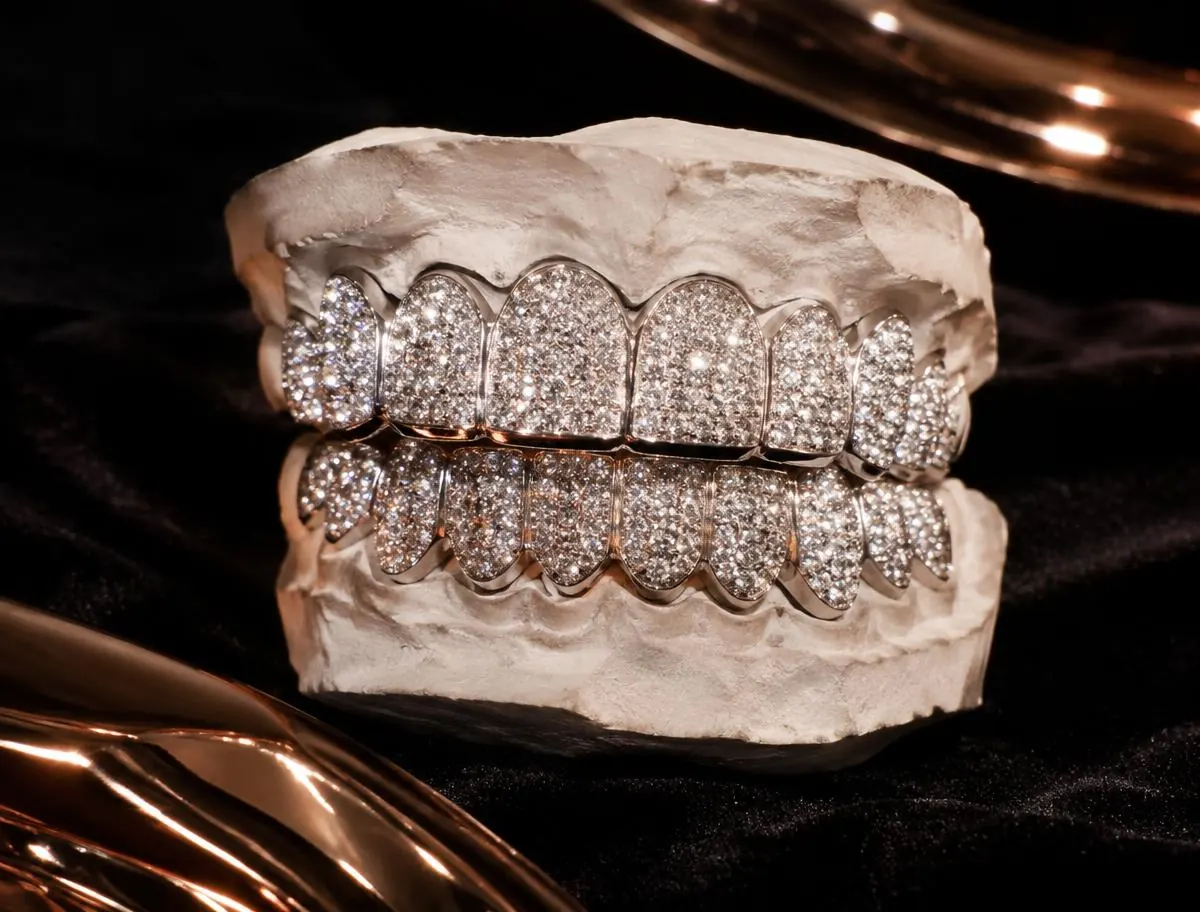
How per-tooth pricing works
Unlike a flat price for "a grillz", Grillz Medellín prices each piece tooth by tooth, because every piece is built to the exact measurements of your mouth. That means the final price depends directly on two choices: how many teeth you want covered (from a single piece to a full arch) and which material you pick for those teeth.
This system is more transparent than a flat price, because it lets you dial in your exact budget to your taste: you could cover just your two front teeth in 18K gold, or a full arch in silver, and the math is always the same: price per tooth multiplied by the number of teeth.
The price-per-tooth table
Solid 925 silver: COP 250,000 per tooth. Chrome / dental gold: COP 320,000 per tooth. 9K gold: COP 900,000 per tooth. 14K gold: COP 1,250,000 per tooth. 18K gold: COP 1,500,000 per tooth. Iced silver with moissanite: from COP 500,000 per tooth. Iced gold with moissanite: from COP 1,250,000 per tooth. Lab-grown or natural diamond: custom quote, no fixed table.
White, yellow and rose gold cost exactly the same within the same karat — colour choice does not change the price. You can see these material and finish combinations in detail at styles before deciding on your combination.
Example 1: a single front piece
A single front tooth in 925 silver costs COP 250,000. The same tooth in 14K gold rises to COP 1,250,000, and in 18K gold reaches COP 1,500,000. If you'd rather have a single piece with a bit of sparkle, one tooth in iced silver starts from COP 500,000.
This single-tooth option is popular with people trying the grillz look for the first time without committing to a full set, or with anyone after a subtle accent rather than a fully covered smile.
Example 2: a six-tooth top set
A set of six front top teeth is one of the most common orders. In 925 silver: 6 × COP 250,000 = COP 1,500,000. In 14K gold: 6 × COP 1,250,000 = COP 7,500,000. In iced silver: 6 × COP 500,000 = COP 3,000,000 at minimum, depending on how many stones each piece carries.
This kind of set gives a very full look to your smile without covering both arches, and is usually the recommended starting point for anyone wanting strong visual impact on a mid-range budget.
Example 3: a full top and bottom arch
For a full arch (typically 8 to 10 teeth per arch, depending on your mouth), the math simply multiplies the per-tooth price by the total number of pieces. In 9K gold, a full 16-tooth arch would work out to 16 × COP 900,000 = COP 14,400,000; in 925 silver, 16 × COP 250,000 = COP 4,000,000.
Because of the sheer number of pieces involved, many people mix materials — gold on the top arch and silver on the bottom, say — to balance budget while keeping an interesting visual contrast between the two.
What moves the final price up or down
The factor that changes the total the most is material: going from silver to 18K gold can multiply the price by six for the same number of teeth. The second factor is how many teeth you cover: every extra tooth adds its own full price, with no volume discount.
For iced pieces, the "from" price can climb depending on the size and density of stones set into each piece; pieces with more or larger stones cost more than the table minimum. For natural or lab-grown diamond, pricing is always quoted individually by stone size, clarity and count, never off a fixed table.
Deposit and balance
A deposit is paid before any piece is cast; the remaining balance is paid on delivery, either in person or when the shipment arrives. This protects both the manufacturing work and your investment: the full amount is never charged upfront before the process even starts.
Turnaround also varies by material: simple silver or chrome pieces take 5 to 10 days, while gold or iced pieces take 10 to 15 days. You can read through the full process, from mould to delivery, in how long does it take to make grillz?.
How to work out your exact budget
The calculation always follows the same formula: per-tooth price of the material you choose, multiplied by the number of teeth you want covered. You can do this math yourself with the table above, or simulate your exact set in the configurator, where you choose material, tooth count and style and see the total before booking anything.
For an overview of every catalogue price in one place, also check the prices page, which summarises the same table alongside turnaround times and the deposit policy.
Where your mould gets taken
No matter how many teeth you're covering, the process always starts with a mould of your mouth, which you can book at the studio or at home in areas like El Poblado, Laureles, Envigado and the rest of the Valle de Aburrá. The mould takes about 20 minutes and is the same step whether you choose silver, gold or an iced piece.
If you want to understand how to find the right service near your area before booking, read grillz near me in Medellín, where we explain what to check before paying any deposit.
Example 4: an eight-tooth set in 9K gold vs. iced
An eight-tooth set is another popular combination, usually covering the whole visible top row when you smile. In 9K gold: 8 × COP 900,000 = COP 7,200,000 (≈US$1,800). In 14K gold: 8 × COP 1,250,000 = COP 10,000,000 (≈US$2,500). In 18K gold: 8 × COP 1,500,000 = COP 12,000,000 (≈US$3,000).
If you'd rather have the same set with sparkle, eight teeth in iced gold start from 8 × COP 1,250,000 = COP 10,000,000 (≈US$2,500) at minimum, rising with the number of stones per piece. By comparison, the same eight-tooth set in 925 silver costs 8 × COP 250,000 = COP 2,000,000 (≈US$500), which shows why material is the variable that moves the final budget the most.
For an eight-tooth iced silver set, the starting point is 8 × COP 500,000 = COP 4,000,000 (≈US$1,000), a middle ground between gold's sparkle and solid silver's lower price.
Example 5: a ten-tooth set and a material comparison
A ten-tooth set usually covers the whole visible arch from side to side on a wide smile. In 925 silver: 10 × COP 250,000 = COP 2,500,000 (≈US$625). In chrome/dental gold: 10 × COP 320,000 = COP 3,200,000 (≈US$800). In 9K gold: 10 × COP 900,000 = COP 9,000,000 (≈US$2,250). In 14K gold: 10 × COP 1,250,000 = COP 12,500,000 (≈US$3,125). In 18K gold: 10 × COP 1,500,000 = COP 15,000,000 (≈US$3,750).
In iced silver, ten teeth start from 10 × COP 500,000 = COP 5,000,000 (≈US$1,250), and in iced gold they start from 10 × COP 1,250,000 = COP 12,500,000 (≈US$3,125) at minimum. Laying out these ten figures side by side makes the jump between karats obvious: silver to 9K gold nearly quadruples the price, and 9K to 18K climbs considerably again.
If your budget sits between these extremes, a common option is mixing materials within the same set — chrome/dental gold on less visible teeth, say, with 14K or 18K gold reserved for just the two or four front teeth.
Iced vs. plain pieces: how pricing differs
A plain piece (no stones) always starts at its material's base price: silver, chrome, or whichever gold karat you pick. An iced piece starts from a higher "from" price, because on top of the metal it includes stone-setting — moissanite in the standard options, or natural/lab-grown diamond under separate quote.
The gap between plain silver (COP 250,000) and iced silver (from COP 500,000) is exactly the cost of moving from a stoneless piece to one with set stones; the same logic applies in gold: plain 14K gold (COP 1,250,000) versus iced gold (from COP 1,250,000, which can climb with stone size and count).
This means you can mix plain and iced pieces within the same set — for example, one iced centre tooth with the rest in plain metal — to concentrate the sparkle where it shows most when you smile, without paying the iced price across your whole mouth.
Why pricing is per tooth, not per set
Charging per tooth, instead of offering fixed packages like a "6-tooth set" or "10-tooth set" at one price, exists because every mouth is different: how many teeth show when you smile varies from person to person, as does the size and shape of each tooth.
A fixed set price would force someone with six small teeth to pay the same as someone with six large teeth, even though the second case uses more material. Charging per tooth means the price always reflects exactly what's built for your mouth, no more and no less.
This model also gives you full control over budget: you can start with two teeth and later add more pieces to the same set, paying only for the new teeth rather than redoing the whole order from scratch.
Deposit, balance and how to plan the payment
The deposit is paid before pieces are cast and secures your spot in production; the balance is paid on delivery, whether you collect in person or receive a shipment. No set is made without a deposit, and no balance is charged before the work is finished.
To plan your payment, it helps to think in two moments: mould day (when you decide material, tooth count and style, and pay the deposit) and delivery day (when you pay the remaining balance and receive your set). Between those two moments is 5 to 15 days, depending on material.
If you're only in Medellín briefly, book your mould as soon as you arrive so delivery lines up with the rest of your trip; see full timing recommendations in Grillz Medellín for visitors: a timeline.
Budgeting tips for visitors and locals
If your budget is tight, starting with 925 silver or chrome/dental gold gets you the same custom fit and the same mould process as gold, at a fraction of the per-tooth price. You can always upgrade material later by adding new pieces to the same set.
If sparkle matters more to you than karat, iced silver usually gives more visual impact for the same budget than plain gold on just a few teeth. If gold's weight and colour are the priority, concentrate gold on the front teeth and use chrome or silver on the less visible side teeth.
Either way, before booking your mould, build your exact set in the configurator to see the total for the tooth count and material you actually want, and also check gold or silver: which grillz to choose if you're still deciding between materials.